Extractives & Natural Resources · Sub-Saharan AfricaExtractives · Sub-Saharan Africa
From Rubaya to Your Phone: How Congo’s Conflict Coltan Becomes Rwandan
Part II of II. By Gray List Global.
Coltan dug under M23 control at Rubaya, the source of about 15 percent of the world’s tantalum, crosses into Rwanda at Goma, is tagged as Rwandan in Kigali, and is trucked to Dar es Salaam for smelters in China and Kazakhstan that supply the makers of electronic capacitors, according to a year-long Global Witness investigation. None of the Rwandan exporters it names has been sanctioned. The mine at the start of the chain is on the list of Congolese assets offered to US investors.
A different road out
Part I followed gold, which leaves eastern Democratic Republic of the Congo (DRC) in small, valuable loads. Coltan, short for columbite-tantalite, is bulk ore. It is refined into tantalum, a heat-resistant metal used mainly in the small capacitors inside phones, laptops and cars. It moves by the tonne, and it moves by road.
The mines around the town of Rubaya, in Masisi territory, North Kivu, supply about 15 percent of world tantalum, according to Global Witness. The March 23 Movement (M23) took control of the roads around them in late 2023 and seized the mines in late April 2024. Before that, a different armed group held them. The US Treasury says PARECO-FF, a militia that UN experts reported in 2025 had supported Congo’s army against M23, controlled mining sites at Rubaya from 2022 to early 2024, imposed forced labor and executed civilians.
What happened
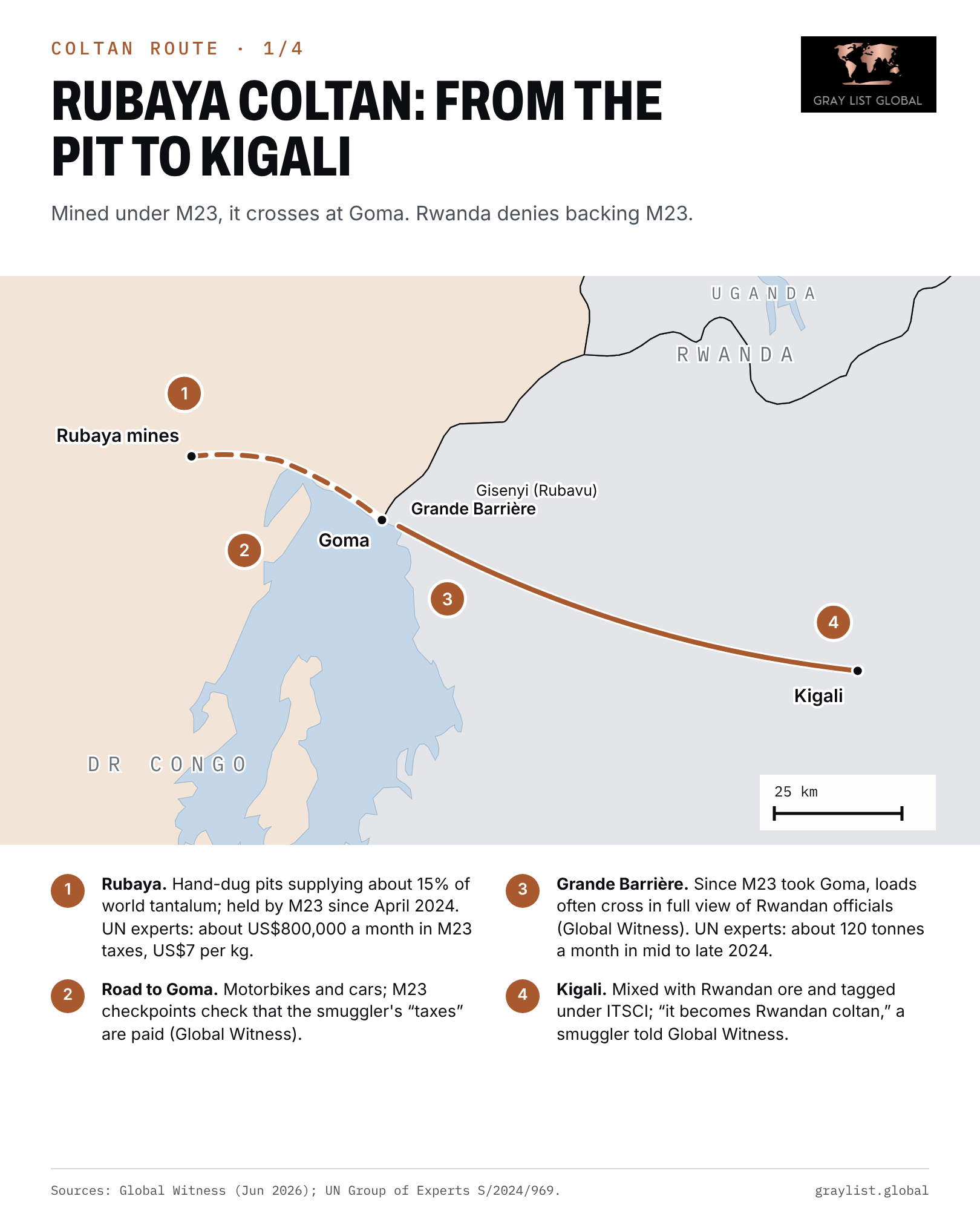
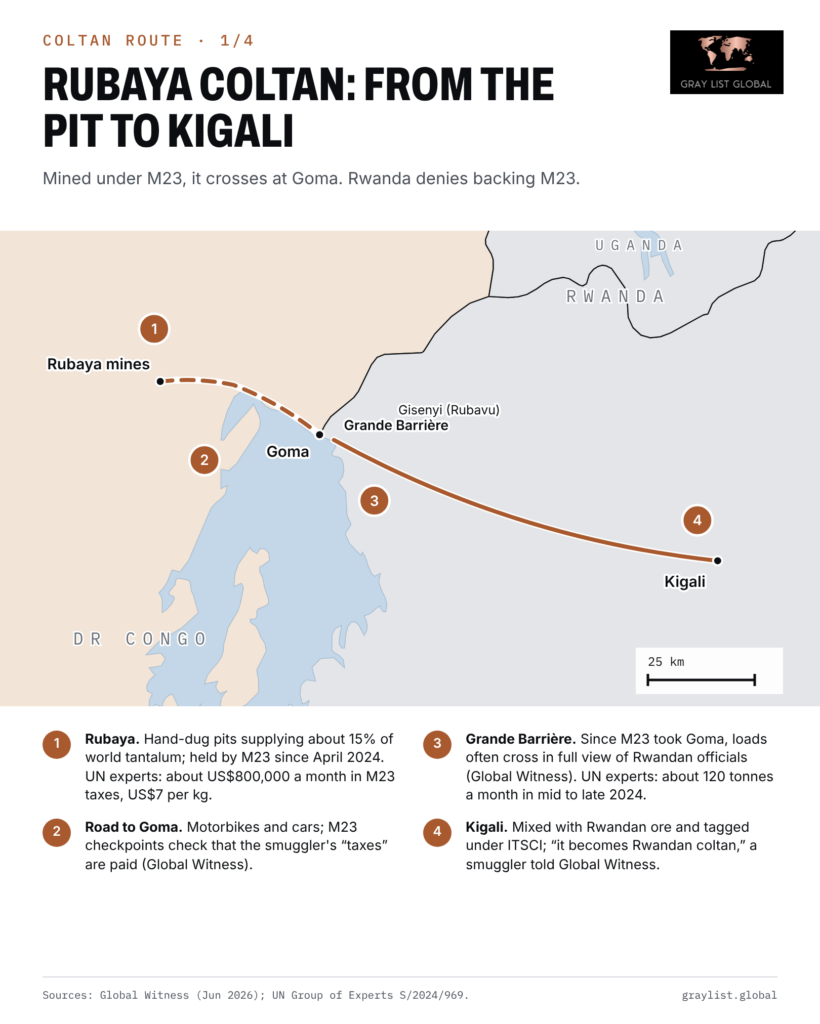
The mine. UN experts reported in December 2024 that M23 was collecting about US$800,000 a month in taxes on coltan production and trade at Rubaya, including a levy of US$7 per kilogram. Global Witness reported in June 2026 that traders pay US$4 per kilogram to M23 and US$3 per kilogram to the Rwandan government. Rwanda’s mining regulator did not respond to Global Witness’s questions, and Rwanda denies backing M23.
Miners dig by hand for a few dollars a day, Reuters reported. Global Witness found children working in the pits and miners who said they are beaten if they defy M23. Amnesty International documented forced labor, torture and killings at Rubaya and at the Lomera gold site in a September 2026 briefing. On 28 January 2026 a landslide at Rubaya killed more than 200 people by early counts, according to the spokesperson for the rebel-appointed governor of North Kivu. In early March another collapse followed. Congo’s Ministry of Mines said at least 200 died, including about 70 children; an M23 official put the toll at about five, and witnesses told AFP at least six died.
The road. Coltan leaves Rubaya by motorbike and car for Goma. Global Witness traveled with a smuggler who had to show M23 fighters at checkpoints that he had paid their “taxes.” Since M23 took Goma in January 2025, loads often cross into Rwanda at the city’s Grande Barrière border post in full view of Rwandan officials, according to Global Witness, which says it found no evidence that Rwandan officials had seized any smuggled coltan in two years. UN experts estimated that M23 controlled the trade and transport of about 120 tonnes a month from mid-May to late October 2024. Global Witness puts the total for M23’s first year at Rubaya at no less than 1,400 tonnes, and probably much more.
The relabeling. In Kigali, smuggled coltan is mixed with Rwandan output and assembled into export cargoes. Most of it leaves with tags from ITSCI, the industry traceability scheme, which covered almost all of Rwanda’s coltan exports in 2023 and 2024. Four traders who sell Rubaya coltan to ITSCI-member exporters told Global Witness their ore is tagged; once the exporter tags it, one smuggler said, “it becomes Rwandan coltan.” Rwanda’s official coltan exports grew more than two and a half times between 2021 and 2025, and coltan has been the country’s second-largest export earner after gold since 2023. Rwanda does not publish mine-level production figures that would allow outsiders to check where the ore comes from. From Kigali, trucks carry the coltan east to the Rusumo border crossing into Tanzania and on to the port of Dar es Salaam, or sometimes Mombasa in Kenya.
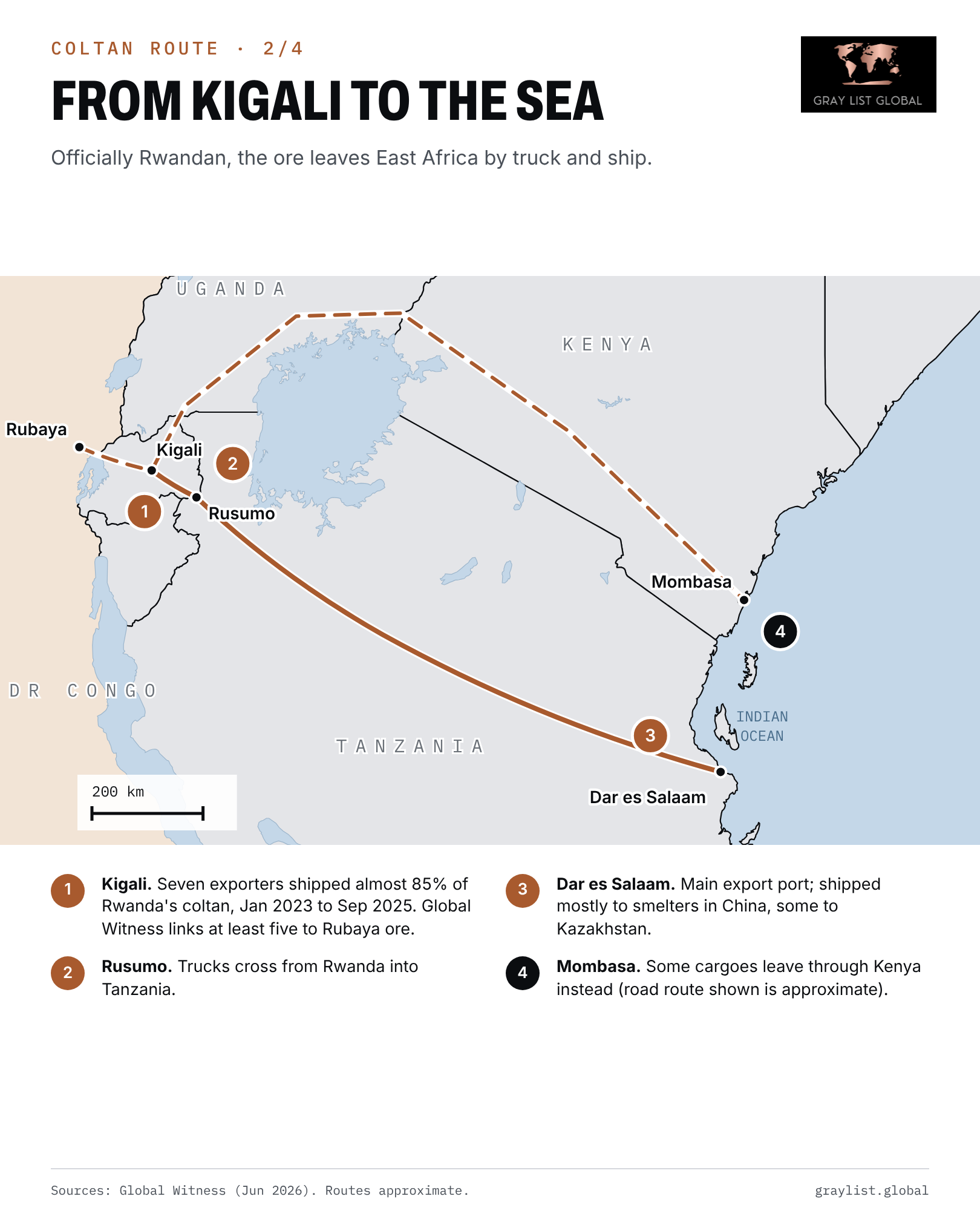
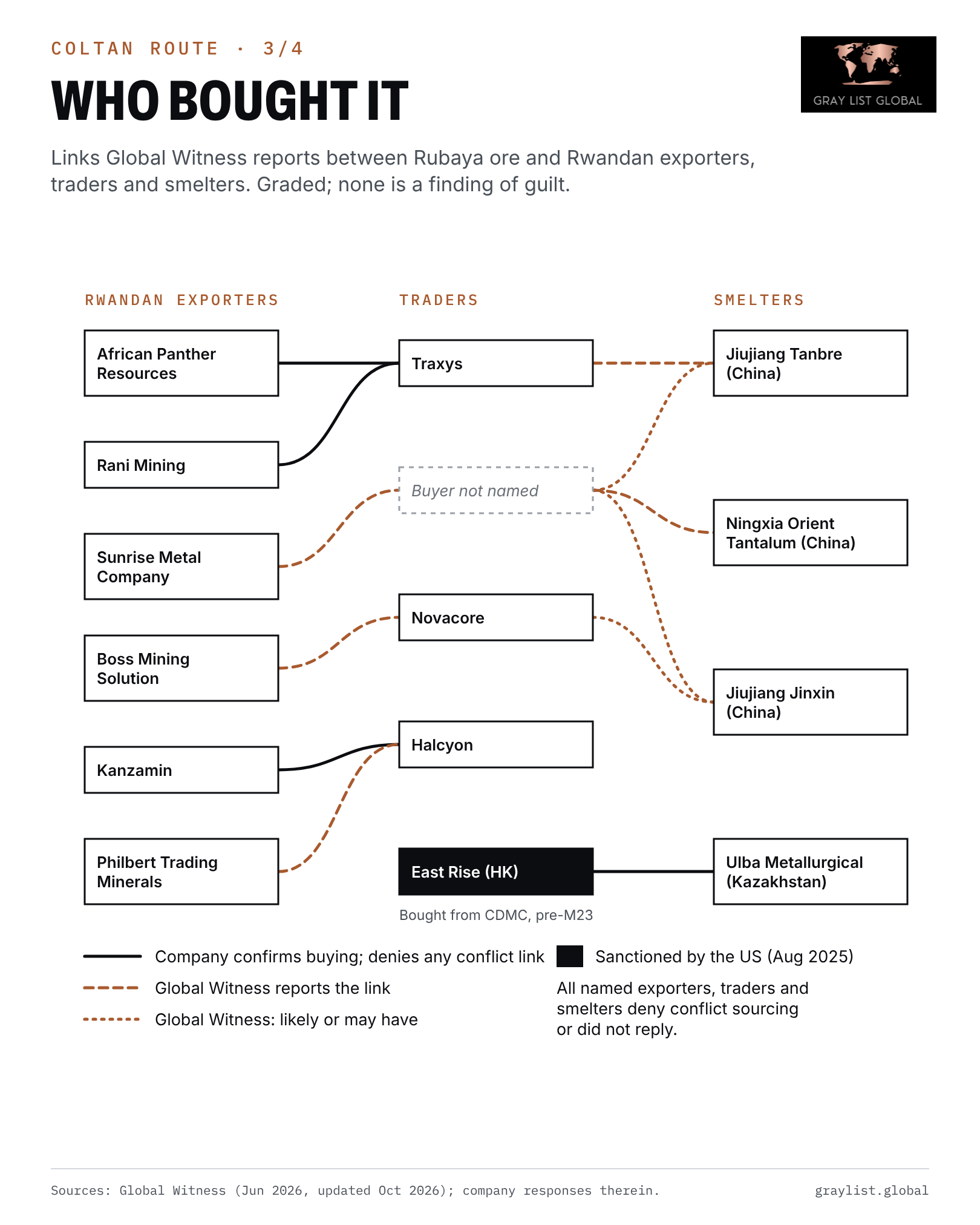
The exporters. Seven Rwandan companies shipped almost 85 percent of Rwanda’s coltan from January 2023 to September 2025, according to customs data Global Witness reviewed. Global Witness says interviews with smugglers gave it direct evidence that at least five of them bought conflict coltan from Rubaya: African Panther Resources, Sunrise Metal Company, Boss Mining Solution, Kanzamin and Philbert Trading Minerals. It says two smaller exporters, Space Mining and Rani Mining, did too. UN experts reported in July 2025 that Boss Mining Solution had bought smuggled Congolese minerals; the company told Reuters it had never bought coltan from Rubaya. African Panther Resources has previously denied sourcing conflict coltan; it and the other six exporters did not reply to Global Witness.
The traders. The direct buyers are based mainly in the United Arab Emirates, China, Hong Kong and Luxembourg. Traxys confirmed buying from African Panther Resources, Rani Mining and Hillside Mining, but strongly denies the ore came from Congo; it says it stopped sourcing tantalum from Rwanda in May 2025. Halcyon confirmed buying from Kanzamin, denies the ore came from Rubaya, says Global Witness offered no transaction-level evidence, and says it has suspended Kanzamin and permanently dropped Philbert Trading Minerals. Novacore, which bought from Boss Mining Solution, says it visited the exporter in Kigali and found no anomalies in its export volumes.
The smelters. Global Witness identified eight smelters that processed most of Rwanda’s coltan, all of which passed audits under the Responsible Minerals Assurance Process (RMAP), the industry’s main smelter audit. It says the evidence suggests at least four of them likely processed Rubaya conflict coltan: Jiujiang Tanbre (China), from African Panther Resources shipped by Traxys and likely from Sunrise Metal Company; Ningxia Orient Tantalum Industry (OTIC, China), from Sunrise; Jiujiang Jinxin Nonferrous Metals (China), which may have sourced from Boss Mining Solution through Novacore and from Sunrise; and Ulba Metallurgical Plant (Kazakhstan), from East Rise Corporation of Hong Kong. The three Chinese smelters deny sourcing conflict material and say their due diligence follows OECD guidance. Ulba confirms buying from East Rise, denies any conflict link and says it stopped buying from the region in May 2024. The Responsible Minerals Initiative, which runs RMAP, calls the claim that its audits cannot ensure smelters are conflict-free unfounded.
The phone. Global Witness found shipments from OTIC to subsidiaries of Samsung and Panasonic in the Philippines, which it says were likely affected by the conflict; Samsung says it had no concerns, citing OTIC’s audit. It reports that Amazon, Microsoft, Vodafone, Toyota, Sony, Nvidia, Honda, LG Display and Ericsson list smelters in their supply chains that, on its evidence, sourced Rubaya coltan, and that Apple listed Ulba in 2023. Global Witness says conflict coltan may have reached these brands. As GLG reads the report, it does not trace ore to any specific device. Apple says it told suppliers to suspend purchases of tin, tantalum, tungsten and gold from Congo and Rwanda as the fighting escalated. Ericsson says the smelters are audited and it will review the cases. Microsoft, Nvidia, LG Display and Panasonic did not reply.
Result
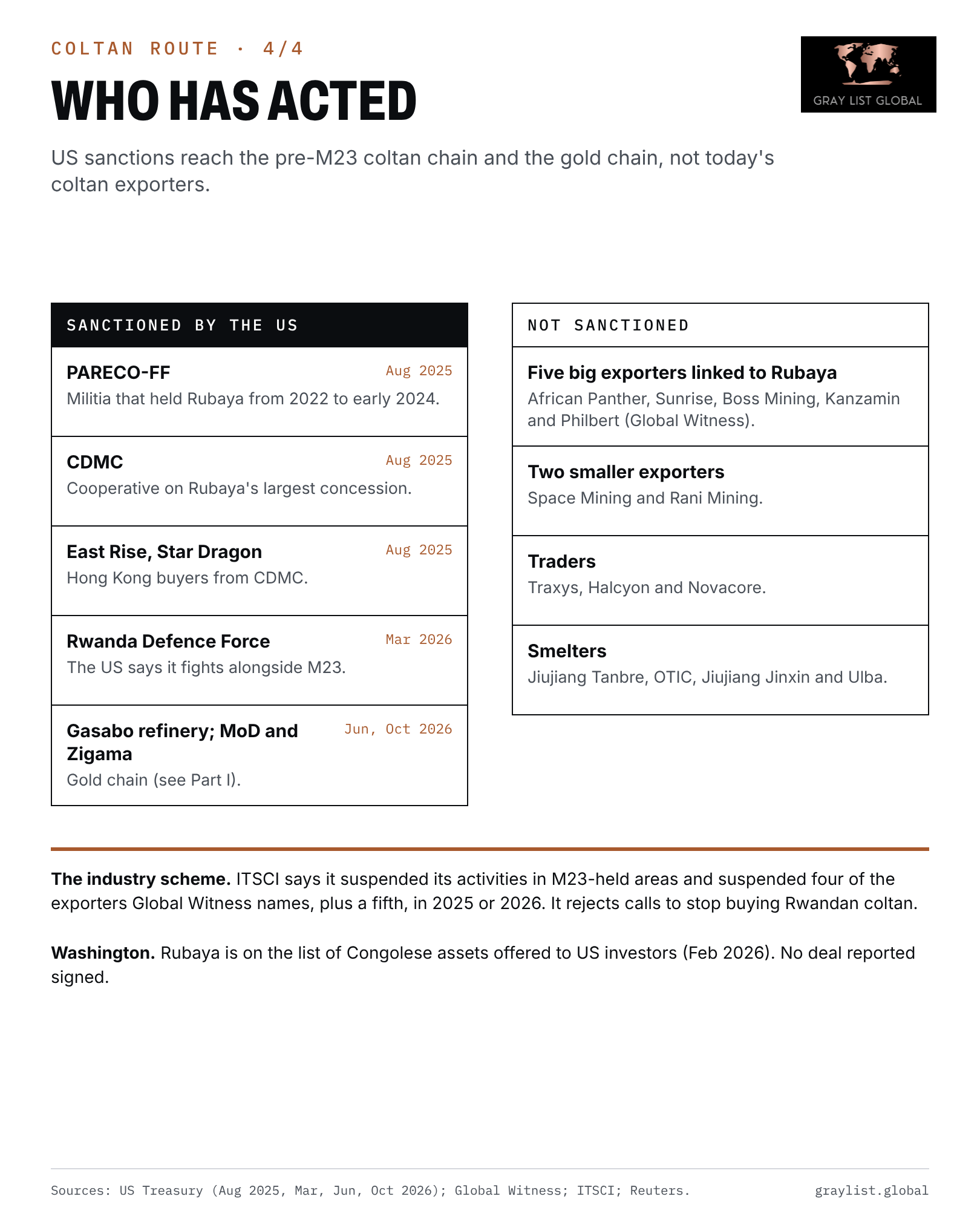
Sanctions. In August 2025 the US Treasury sanctioned PARECO-FF; CDMC, a Congolese cooperative that operated on Rubaya’s largest concession and that Treasury says sold minerals smuggled from PARECO-FF areas; and East Rise and Star Dragon, two Hong Kong exporters that bought from CDMC. Those findings cover the period before M23 arrived. CDMC rejects the allegations. Since then Treasury has sanctioned the Rwanda Defence Force (March 2026), the Gasabo gold refinery network (June 2026), and Rwanda’s Ministry of Defence and Zigama Credit and Savings Society (October 2026), as Part I described. Apart from East Rise, sanctioned for its purchases from CDMC, none of the Rwandan exporters, traders or smelters that Global Witness links to Rubaya coltan has been sanctioned.
The scheme. ITSCI says it suspended its activities in all areas under M23 control, that four of the exporters Global Witness lists were suspended in 2025 or 2026, and that a fifth exporter, not named by Global Witness, was suspended in 2026. It calls Global Witness’s call for blanket disengagement from Rwanda inconsistent with OECD guidance and says the report identifies no specific shipment linked to conflict financing. Global Witness reports that at least two exporters suspended by ITSCI now work with Better Mining, a rival scheme, and a third is being onboarded; Better Mining denies tagging conflict coltan.
Rubaya on the US list. In December 2025 the US and Congo agreed a strategic minerals partnership alongside the Washington Accords. On 5 February 2026 Congo presented Washington with a shortlist of assets for US investors that included Rubaya, according to a government document seen by Reuters and confirmed by a Congolese official and a US diplomat. The document says Rubaya could supply “fully traceable, conflict-free” tantalum and would need US$50 million to US$150 million to restart. Kinshasa does not control the site; an M23 official told Reuters the offer was meant to draw the US into retaking it. Days later, forces allied to Congo’s army launched a drone-led offensive on Rubaya, The Globe and Mail reported. In April a State Department official said US companies showed significant interest and that any investment would have to align with the peace process. In August Congo and M23 agreed a roadmap for further talks under the Doha framework. GLG found no report of a signed US deal on Rubaya, and no report that M23 has left the mines.
Impact (GLG analysis)
The label is the weak point. On Global Witness’s evidence, the tag applied in Kigali is where Rubaya ore acquires a clean identity, and every check after it (the exporter’s paperwork, the trader’s due diligence, the smelter audit) relies on that tag. ITSCI and the Responsible Minerals Initiative dispute this. But no one in the chain can measure it independently: Rwanda publishes no mine-level production data and, according to an expert cited by Global Witness, has declined to use the geochemical fingerprinting tool that Germany developed to test where ore was mined.
The mine pays whoever holds it. Rubaya financed PARECO-FF, which UN experts say supported Congo’s army, before it financed M23. US sanctions have reached the earlier chain, from CDMC to the Hong Kong buyers, and the gold chain through Kigali. They have not reached the chain that runs through Rwandan coltan exporters today. That is the same gap Part I found on the northern gold road.
Two roles for Washington (GLG inference). The United States is the main enforcer against conflict-mineral financing in the region and a prospective investor in the mine at the center of it. The “fully traceable, conflict-free” supply Kinshasa promises would need a traceability system that, on Global Witness’s evidence, the region’s main scheme has not provided at Rubaya, and the mine’s largest concession has been operated by a cooperative that Treasury has sanctioned.
The picture. The same pits that killed hundreds of miners this year pay M23 by the kilogram, feed Rwanda’s second-largest export, and sit on a list of assets offered to American investors. Between the pit and the capacitor, the ore passes a border post, an exporter, a trader, a smelter and an audit, and at each step it carries the label it was given in Kigali. For a compliance team, a tag from Rwanda and an audited smelter are where the questions begin: where the ore was dug, by whom, and who was paid to let it cross.
Quick reference
Places
- Dar es Salaam: Tanzanian port from which most Rwandan coltan is shipped; some goes through Mombasa, Kenya.
- Grande Barrière: main border post between Goma and Gisenyi (Rubavu), Rwanda.
- Kigali: Rwanda’s capital, where exporters assemble and tag coltan cargoes.
- Rubaya: coltan mining town and area in Masisi territory, North Kivu, 60 to 70 km west of Goma; held by M23 since April 2024.
- Rusumo: border crossing from Rwanda into Tanzania.
Groups and companies
- CDMC (Coopérative des Artisanaux Miniers du Congo): cooperative that operated on Rubaya’s largest concession; sanctioned by the US in August 2025.
- East Rise Corporation and Star Dragon Corporation: Hong Kong exporters; sanctioned by the US in August 2025 for buying from CDMC.
- Global Witness: London-based investigative group; author of “Who buys Rwanda’s smuggled coltan?” (June 2026).
- M23: rebel group holding much of North and South Kivu; see Part I.
- PARECO-FF: militia that held Rubaya from 2022 to early 2024; sanctioned by the US in August 2025.
Minerals, schemes and rules
- Better Mining: traceability scheme run by SLR Consulting; a rival to ITSCI in Rwanda.
- Coltan: columbite-tantalite ore, the main source of tantalum.
- ITSCI: industry traceability scheme that tags bags of tin, tantalum and tungsten ore; dominant in Rwanda.
- OECD Due Diligence Guidance: international standard for sourcing minerals from conflict-affected areas.
- RMAP / Responsible Minerals Initiative: industry audit of smelters and refiners, and the body that runs it.
- Tantalum: heat-resistant metal refined from coltan, used mainly in capacitors for electronics and cars.
- Full series reference: graylist.global/congo-reference.
Sources
- Global Witness, “Who buys Rwanda’s smuggled coltan?”, 10 June 2026 (updated 28 October 2026). https://globalwitness.org/en/campaigns/transition-minerals/who-buys-rwandas-smuggled-coltan-the-global-journey-of-conflict-coltan-from-drc-to-the-worlds-electronics/
- ITSCI, response to Global Witness, 12 June 2026. https://www.itsci.org/2026/06/12/itsci-response-to-global-witness-report-on-rwandas-coltan/
- US Treasury, sanctions on PARECO-FF, CDMC, East Rise and Star Dragon, 12 August 2025 (press release sb0221). https://home.treasury.gov/news/press-releases/sb0221
- Bloomberg via Mining.com, 13 August 2025 (CDMC response). https://www.mining.com/web/us-sanctions-armed-group-mining-firms-over-illicit-congo-minerals
- Reuters via TimesLIVE, 13 August 2025 (UN experts on PARECO-FF support to the army). https://www.timeslive.co.za/news/africa/2025-08-13-watch–us-imposes-sanctions-on-drc-armed-group-pareco-ff-mining-firms-over-illicit-minerals/
- UN Group of Experts on the DRC, final report, S/2024/969, 27 December 2024. https://docs.un.org/en/s/2024/969
- UN Group of Experts on the DRC, S/2025/446 (2025). https://docs.un.org/en/s/2025/446
- Reuters via Mining.com, 3 July 2025 (Boss Mining Solution). https://www.mining.com/web/major-rwandan-coltan-exporter-bought-smuggled-congolese-minerals-un-report-says/
- Reuters via Mining.com, 13 August 2025 (inside Rubaya). https://www.mining.com/web/inside-the-mine-that-feeds-the-tech-world-and-funds-congos-rebels/
- Reuters via Mining.com, 18 February 2026 (Rubaya on the US shortlist). https://www.mining.com/web/congo-offers-tantalum-deposit-under-m23-control-to-us-in-minerals-pact/
- Reuters via WHBL, 20 April 2026 (State Department on US interest). https://whbl.com/2026/04/20/us-companies-eye-congo-mining-assets-including-rubaya-state-dept-official-says/
- The Globe and Mail, February 2026 (offensive on Rubaya). https://www.theglobeandmail.com/world/article-congo-troops-assault-coltan-rich-town-after-site-is-offered-to-us/
- Reuters via The National, 1 February 2026 (January collapse). https://www.thenationalnews.com/news/2026/02/01/more-than-200-killed-in-mine-collapse-in-eastern-drc
- AP via WTOP, March 2026 (March collapse; M23 disputes toll). https://wtop.com/world/2026/03/at-least-200-dead-in-a-congo-coltan-mine-collapse-authorities-say-as-rebels-dispute-toll
- AFP via The Standard, 4 March 2026. https://www.thestandard.ke/business/amp/africa/article/2001542240/at-least-six-die-in-dr-congo-mine-collapse
- Al Jazeera, 4 March 2026 (about 70 children). https://www.aljazeera.com/news/2026/3/4/more-than-200-killed-in-landslide-at-drc-coltan-mine
- Global Witness, press release on the January 2026 collapse (children in the mines). https://globalwitness.org/en/press-releases/deadly-drc-mine-disaster-highlights-human-cost-of-coltan/
- Amnesty International, September 2026. https://www.amnesty.org/en/latest/news/2026/09/drc-m23-fighters-abused-miners-and-trafficked-gold-and-coltan-to-rwanda/
- Al Jazeera, 23 August 2026 (DRC-M23 roadmap). https://www.aljazeera.com/news/2026/8/23/dr-congo-m23-rebels-agree-on-roadmap-for-peace-talks
Gray List Global analysis is based on open sources and is not legal, financial, or compliance advice. Named parties are presumed innocent unless proven guilty. See our Disclaimer.
The Gray List Brief
The cards are public. Subscribe to get the full analysis.