Extractives & Natural Resources · Sub-Saharan AfricaExtractives · Sub-Saharan Africa
Two Gold Corridors Out of Eastern Congo: One Is Sanctioned, One Is Not
Part I of II. By Gray List Global.
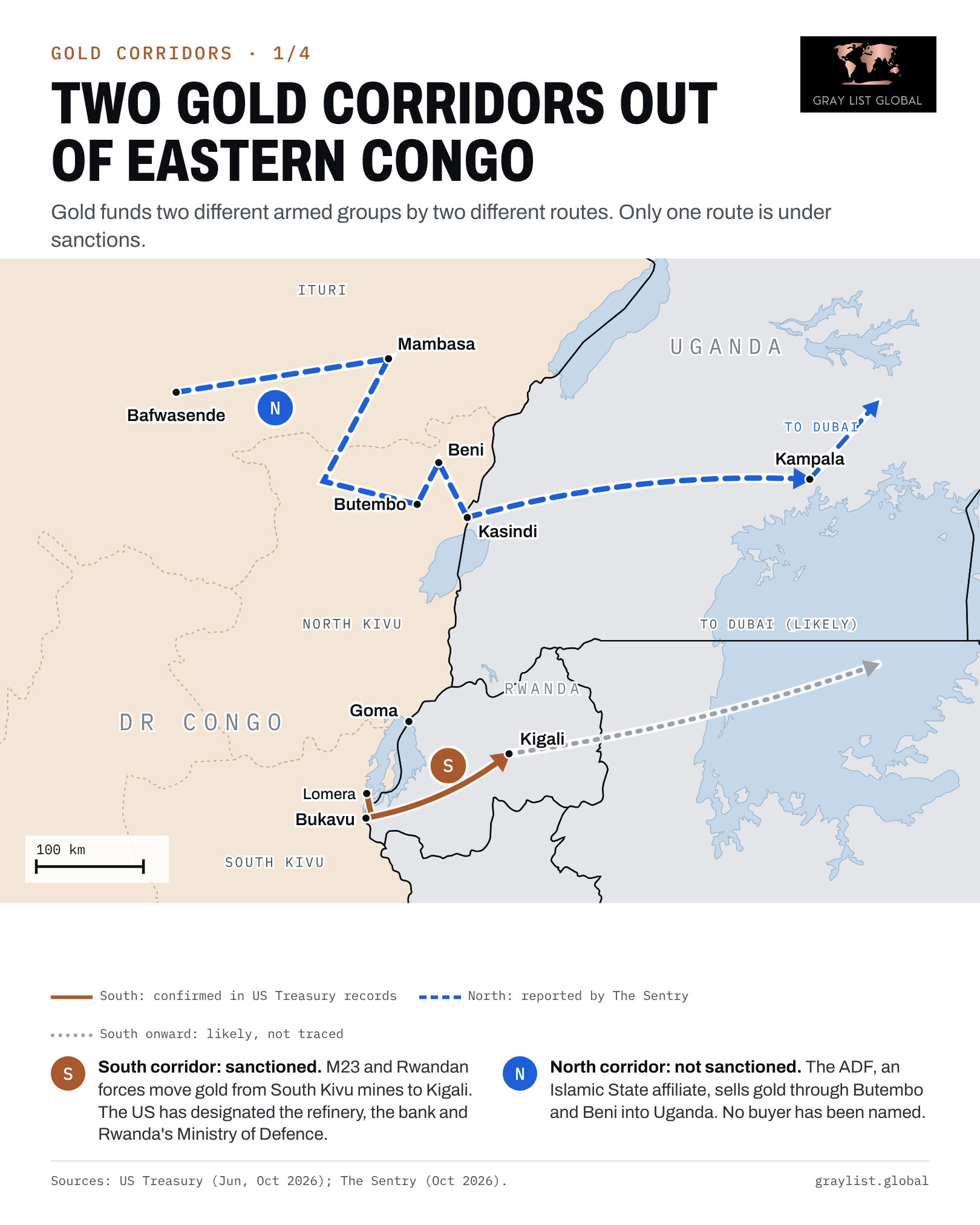
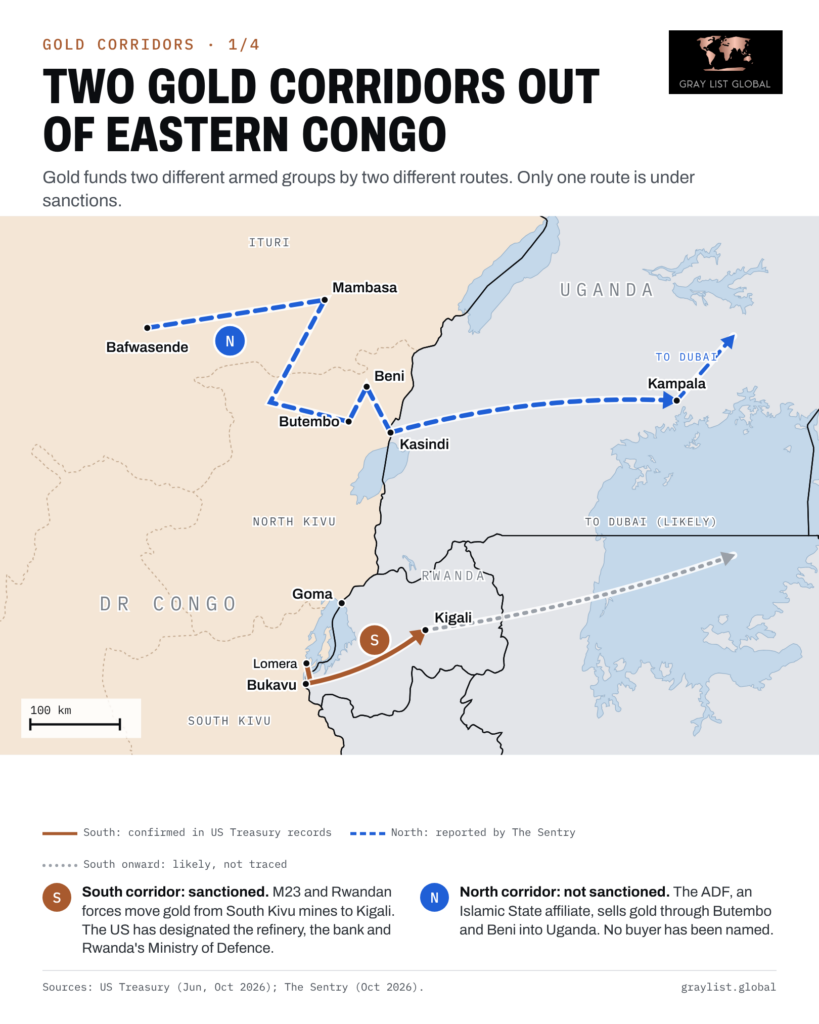
Gold from eastern Congo leaves by two routes that pay for two different armed groups. The southern route, which serves M23 and the Rwandan forces that back it, is now documented in US sanctions records from the mine to the bank. The northern route, which an October 2026 investigation says has become the main income of an Islamic State affiliate, runs through Uganda, and nobody on it has been sanctioned.
Two wars, one resource
Eastern Democratic Republic of the Congo (DRC) hosts more than one war. In the Kivu provinces, the March 23 Movement (M23), which took Goma in January 2025 and Bukavu in February 2025, fights the Congolese army alongside the Rwanda Defence Force (RDF), according to the conflict monitor ACLED. UN experts estimated that 6,000 to 7,000 RDF personnel were deployed in North and South Kivu in late 2025. Kinshasa calls M23 a Rwandan proxy. Rwanda denies backing it and says its security concern is the FDLR, a Hutu militia formed by perpetrators of the 1994 genocide. Further north, the Allied Democratic Forces (ADF), which the US designated as a foreign terrorist organization in 2021 under the name ISIS-DRC, attacks civilians in North Kivu and Ituri while Uganda’s army pursues it under Operation Shujaa.
Gold connects them. It is portable, easy to sell and hard to trace once refined. Two reports published within a week of each other in October 2026 show how it moves.
What happened
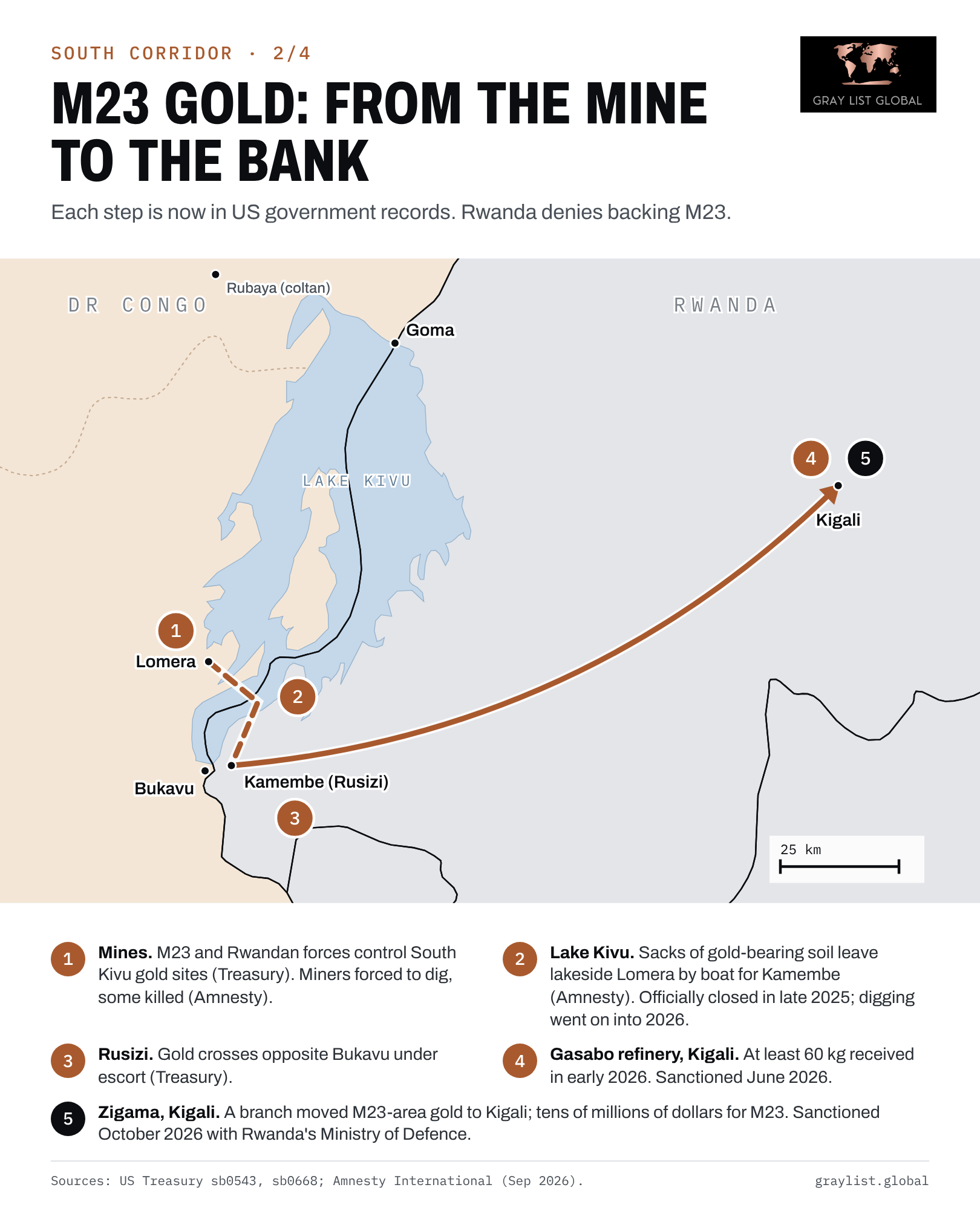
The southern corridor. On 28 October 2026 the US Treasury sanctioned Rwanda’s Ministry of Defence and Zigama Credit and Savings Society, a financial institution that Treasury says operates on behalf of Rwanda’s security services. Treasury says the RDF and M23 control gold mining sites in South Kivu, that Rwandan forces keep “strict oversight” of the gold once it leaves the sites, and that a Zigama branch “enabled the transportation of gold sourced from M23-controlled territory in eastern DRC to Kigali.” It says Zigama handled transactions for M23 and its political wing “amounting to tens of millions of dollars,” without saying over what period.
That action completed a chain Treasury began in June. On 25 June 2026 it sanctioned Gasabo Gold Refinery LTD in Kigali, its chairman Jean Malic Kalima, its general manager Bosco Kayobotsi and three Rwandan mining companies Kalima controls. Treasury said at least 60 kilograms of gold moved from eastern DRC to Gasabo in early 2026, carried under RDF and M23 escort from M23-held areas to Rusizi District, across the border from Bukavu, and on to Kigali.
The trade has not stopped. Treasury’s 60-kilogram finding covers early 2026, more than a year after M23 took Bukavu. The UN Group of Experts reported on 30 December 2025 that M23 took control of the Lomera artisanal gold site in South Kivu’s Kabare territory in mid-February 2025, replaced state mining officials with its own “mining office” and imposed a 30 percent production tax on the sale price of ore at the pit, with well over 5,000 miners at work. The same report names a semi-mechanized gold operation under M23 at Karhembu, in Walungu territory. M23 also seized the industrial Twangiza mine in May 2025. Its operator told Reuters that at least 500 kilograms of gold, worth about US$70 million, had been taken by October 2025. Corneille Nangaa, the leader of M23’s political wing, denied it, saying the mine was inactive. The experts also note that most of South Kivu’s gold mining takes place in areas held by the Congolese army and allied militias, not M23.
M23 suspended mining at Lomera on 30 August 2025, citing tensions with miners, and later announced its closure. Amnesty International found that digging went on. In a briefing published in September 2026, based on 26 interviews conducted between January and April 2026 and on analysis by its Evidence Lab, Amnesty said soil containing gold from Lomera “was loaded onto boats at the Port of Lomera” and taken across Lake Kivu to a sand collection port in Kamembe, in Rusizi. “Each morning, they came with traders from Rwanda,” one miner said. A miner described working at the site in March 2026, and satellite imagery showed fresh clearing in June 2026. The briefing also documented forced labor, torture and the killing of 18 miners at Lomera and the Rubaya coltan mine.
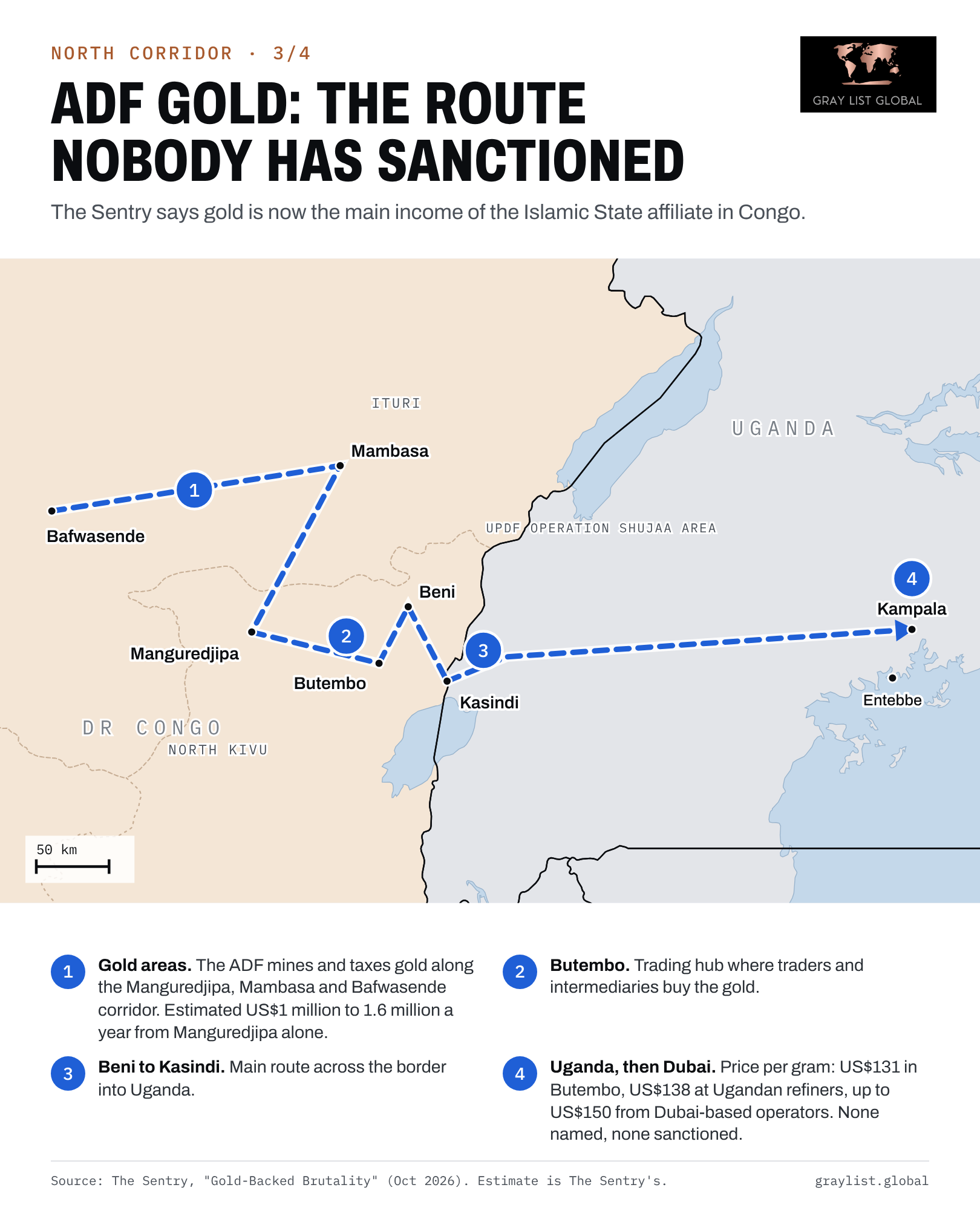
The northern corridor. On 27 October 2026 The Sentry, a Washington-based investigative group, published “Gold-Backed Brutality,” reporting that the ADF’s financing has shifted from Islamic State transfers to “conflict gold that is trafficked to Uganda.” The Sentry places the ADF’s gold economy along a corridor running through Manguredjipa, Mambasa and Bafwasende, with Butembo as the main trading hub and the Beni-Kasindi road as a route into Uganda.
The report traces the price of a gram as it moves: about US$123 paid by local traders in Manguredjipa, about US$131 at buying houses in Butembo, about US$138 at Ugandan refiners and about US$147 to US$150 from Dubai-based operators, against an international price of about US$155 (January 2026 prices). It estimates that ADF-influenced sites around Manguredjipa produce about 800 kilograms of gold a year and that at least 30 of the 54 gold buyers still operating in Manguredjipa in March 2026 knowingly bought from ADF-controlled sites. It estimates the ADF earns between US$1 million and US$1.6 million a year from the Manguredjipa area alone, a figure The Sentry bases on revenue shares observed for other armed groups rather than on a measured total.
Result
The southern corridor is now largely on the US sanctions list. The RDF was designated in March 2026; Gasabo, its two executives and three mining companies in June; Rwanda’s Ministry of Defence and Zigama in October. The European Union had sanctioned Gasabo earlier, in March 2025. In August 2025 the International Conference on the Great Lakes Region, a regional body, set up a commission of inquiry into smuggling of minerals and gold from Congo to Rwanda since 2022, over Rwanda’s objection.
The northern corridor has no designations. The Sentry names no Ugandan refiner, exporter or Dubai buyer. It calls on the UN Security Council, the United States, the United Kingdom and the European Union to investigate the supply chains linking eastern DRC to Ugandan “trading, refining and export networks,” and says traders, refiners, exporters and financiers that knowingly or negligently launder ADF gold “should be considered for designation under paragraph 7(g) of UN Security Council Resolution 2293 (2016).”
Rwanda rejects the premise of the October sanctions. Government spokesperson Yolande Makolo said “Rwanda remains ready to fully implement the Washington Accords” and that commitments on the FDLR remain unmet, according to the BBC, and that “all parties must be held accountable,” according to RFI. Uganda’s army and government did not respond to Reuters’ requests for comment on The Sentry’s findings.
Impact (GLG analysis)
Two enforcement postures. Washington has acted on the corridor that runs through a state it is pressing to honor the Washington Accords. It has not yet acted on the one that funds an Islamic State affiliate, even though an investigative group has mapped that trade down to the price paid at each stage.
The numbers point the same way. Rwanda exported about US$1.5 billion in gold, more than 19 tonnes, in 2024, according to its prime minister. In 2025, after the EU sanctioned Gasabo, its gold exports fell to about US$517 million, according to IMF data reported by Bloomberg. In November 2025 President Paul Kagame acknowledged that “more gold comes from, and has been coming through here or sold here, from Congo,” and called the controversy geopolitics. Over the same year Uganda’s gold exports nearly doubled, from about US$3.3 billion to about US$6.4 billion, according to the Bank of Uganda. A deputy governor of the bank noted that gold is also Uganda’s largest import, that the net gain is about US$200 million, and that this “raises questions about the origins of some of this gold.” Higher gold prices explain part of Uganda’s rise, but not a doubling, and not Rwanda’s fall.
Where the routes likely meet. The Sentry places Dubai-based operators at the end of the northern chain. Treasury does not name the destination of Gasabo’s refined gold. Dubai has long been the main market for the region’s conflict-affected gold, but GLG has not traced the southern route’s gold beyond Kigali.
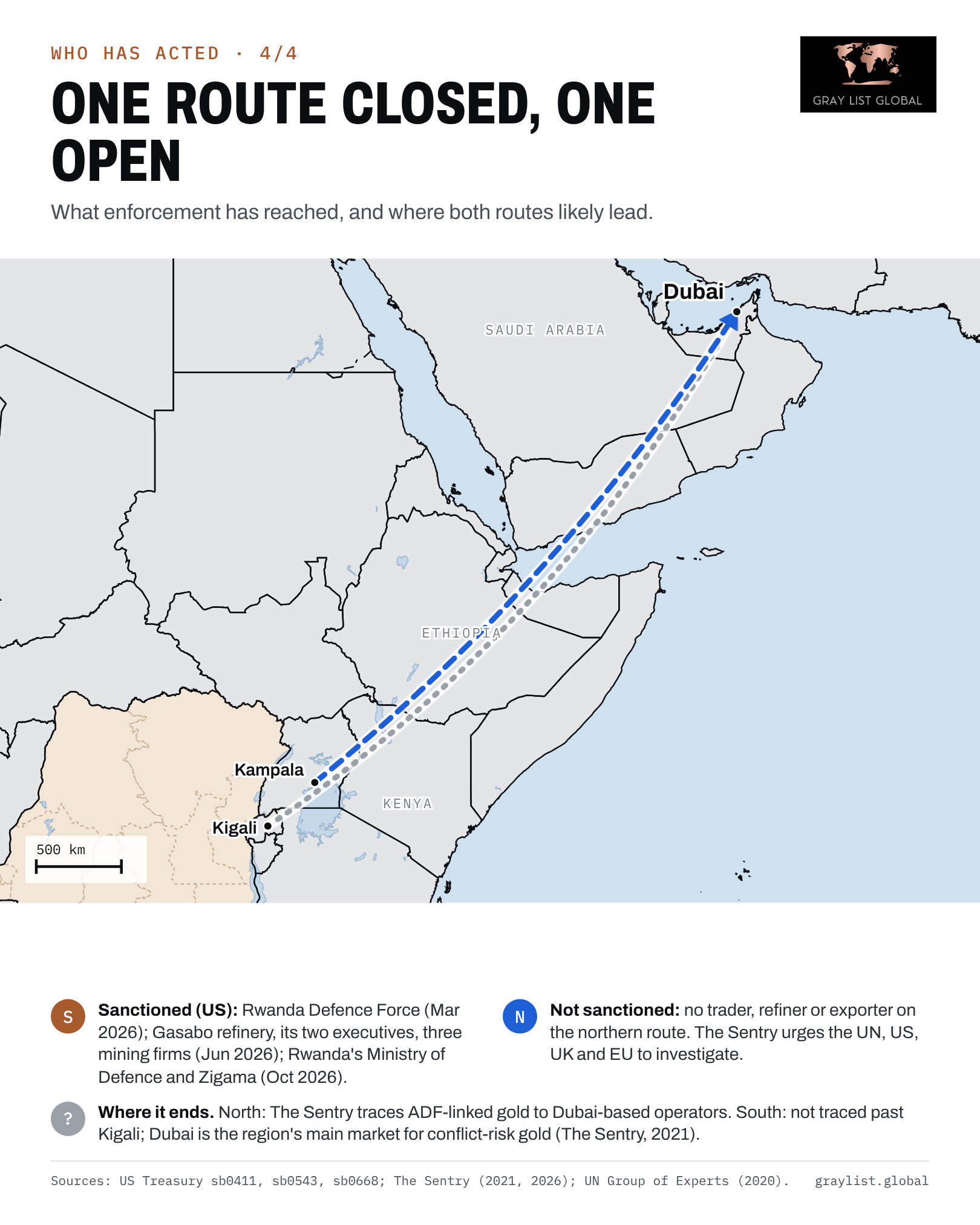
The picture. Sanctions have put names on one road out of eastern Congo: the escort, the crossing, the refinery, the bank. They have not stopped the gold, which was still being dug at Lomera this year, and they have not touched the second road, where every step from the mine to Dubai has a price but no name. In 2025, as Rwanda’s gold exports fell by about two-thirds, Uganda’s nearly doubled. GLG cannot show that the gold changed roads. But anyone buying gold labeled Ugandan now has to be able to say where it was dug, and The Sentry’s work suggests that for gold from Manguredjipa, that answer is an Islamic State affiliate.
Part II follows the other mineral that leaves eastern Congo for Rwanda: coltan, from the Rubaya mine to the world’s electronics supply chain.
Quick reference
- M23: rebel group fighting the Congolese government in the Kivus since 2021; took Goma and Bukavu in early 2025. Its political wing, the AFC, was succeeded in October 2026 by Joseph Kabila’s Front for the Refoundation of the Nation.
- RDF: Rwanda Defence Force; the US says it fights alongside M23 and sanctioned it in March 2026.
- FDLR: Hutu militia formed by perpetrators of the 1994 genocide; Rwanda’s stated security concern.
- ADF: Allied Democratic Forces, the Islamic State affiliate in Congo (designated by the US as ISIS-DRC), active in North Kivu and Ituri.
- UPDF: Uganda’s army; pursues the ADF inside Congo under Operation Shujaa.
- Zigama Credit and Savings Society: Rwandan financial institution serving the security services; sanctioned with Rwanda’s Ministry of Defence on 28 October 2026.
- Gasabo Gold Refinery (Kigali): sanctioned 25 June 2026 with chairman Jean Malic Kalima, general manager Bosco Kayobotsi and three mining companies Kalima controls.
- Lomera: lakeside artisanal gold site in Luhihi, Kabare territory, South Kivu.
- Kamembe / Rusizi: town and district in western Rwanda across from Bukavu; landing point for gold from Congo.
- Twangiza and Karhembu: industrial and semi-mechanized gold mines in South Kivu under M23 control.
- Manguredjipa: gold trading center in Lubero territory, North Kivu; center of the ADF’s gold economy, per The Sentry.
- Butembo: North Kivu trading city whose buying houses sell gold to Ugandan refiners.
- Kasindi: border crossing into Uganda on the road east of Beni.
- Doré: partly refined gold bar, poured before final refining.
- E.O. 13413: 2006 US executive order authorizing sanctions related to the DR Congo conflict.
- UN Security Council Resolution 2293, paragraph 7(g): allows UN sanctions on those who support armed groups through the illicit trade in natural resources.
- Washington Accords: US-brokered DR Congo-Rwanda peace agreement signed on 4 December 2025.
- GLG link grades: Confirmed (stated in an official record), Reported (credible reporting or investigation, named), Inferred (GLG’s own analysis, labeled as such).
- Full series reference: graylist.global/congo-reference.
Sources
- US Treasury, sb0668, 28 October 2026. https://home.treasury.gov/news/press-releases/sb0668
- US Treasury, sb0543, 25 June 2026. https://home.treasury.gov/news/press-releases/sb0543
- US Treasury, sb0411, 2 March 2026. https://home.treasury.gov/news/press-releases/sb0411
- The Sentry, “Gold-Backed Brutality,” October 2026. https://thesentry.org/reports/gold-backed-brutality-adf/
- Amnesty International, September 2026 (briefing AFR 62/1454/2026). https://www.amnesty.org/en/latest/news/2026/09/drc-m23-fighters-abused-miners-and-trafficked-gold-and-coltan-to-rwanda/
- UN Group of Experts on the DRC, midterm report, S/2025/858, 30 December 2025 (paras. 56 to 68 and 89 to 91). https://docs.un.org/en/S/2025/858
- Reuters via Mining.com, 21 October 2025 (Twangiza). https://www.mining.com/congo-rebels-loot-70m-in-gold-from-twangiza-mine/
- Daily Monitor (Bank of Uganda export data). https://www.monitor.co.ug/uganda/business/commodities/2025-uganda-s-exports-hit-record-shs46-trillion–5320056
- Radio Okapi, 5 November 2025. https://www.radiookapi.net/2025/11/05/actualite/societe/fermeture-definitive-du-site-minier-de-lomera-par-lafc-m23
- Reuters via Daily Monitor, 28 October 2026. https://www.monitor.co.ug/uganda/news/national/gold-smuggling-funds-adf-in-eastern-congo-report-says-5649586
- BBC, 29 October 2026 (via AOL). https://www.aol.com/articles/us-sanctions-rwandas-defence-ministry-071604000.html
- RFI via AllAfrica, 29 October 2026. https://fr.allafrica.com/stories/202610290212.html
- KT Press, 28 November 2025. https://www.ktpress.rw/2025/11/where-does-rwanda-get-its-1-5bn-gold-exports-yes-some-of-it-comes-from-dr-congo/
- The New Times, 28 March 2025. https://www.newtimes.co.rw/article/25225/news/economy/rwanda-records-15bn-in-gold-exports-in-2024/amp
- Bloomberg via Mining.com, 25 June 2026. https://www.mining.com/web/us-sanctions-rwandan-refinery-in-congo-gold-smuggling-network/
- Radical Leap, 13 February 2026 (Bank of Uganda remarks). https://www.radicalleap.com/2026/ugandas-gold-exports-jump-to-6-4-billion-in-2025-but-net-trade-gain-stands-at-200million/
- ACLED, March 23 Movement profile. https://acleddata.com/armed-group/march-23-movement-m23
- The Sentry via OCCRP, 24 February 2021 (Dubai as main market). https://occrp.org/en/news/report-4-billion-in-african-conflict-gold-floods-world-markets
Gray List Global analysis is based on open sources and is not legal, financial, or compliance advice. Named parties are presumed innocent unless proven guilty. See our Disclaimer.
The Gray List Brief
The cards are public. Subscribe to get the full analysis.