Myanmar’s civil war is often described in terms of villages burned, civilians displaced, and resistance groups fighting the junta. But beneath those headlines lies another story: one about pipelines, money, and how the country’s most strategic resource corridors became lifelines for the military regime and its foreign partners.
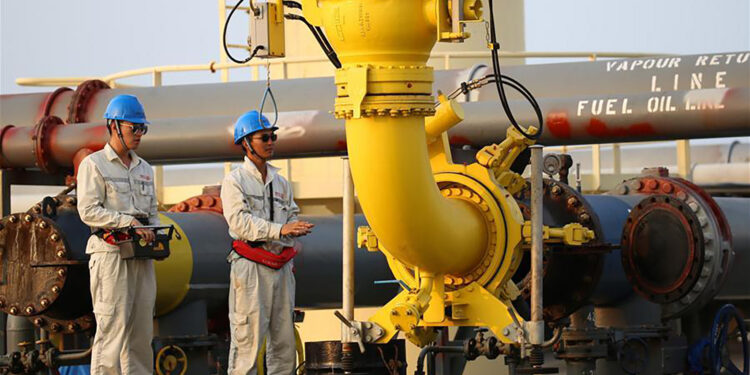
From the port of Kyaukphyu in Rakhine State, two parallel pipelines run northeast across Myanmar into China’s Yunnan Province. One carries crude oil shipped in from the Middle East and Africa, while the other transports natural gas from offshore fields. For Beijing, the 770-kilometer corridors reduce dependence on the Malacca Strait, a potential chokepoint in any conflict. For Myanmar’s generals, they are the single most reliable source of foreign currency left.
The revenues are enormous. The natural gas pipeline delivers up to 12 billion cubic meters annually, generating an estimated one to one and a half billion dollars in payments to Myanmar’s state oil company MOGE. The crude oil pipeline adds hundreds of millions more, bringing total annual earnings from the twin projects into the range of one and a half to two billion dollars. That cash goes directly into junta-controlled accounts, even as the economy collapses elsewhere under sanctions and war.
The Irrawaddy reported in September 2025 how these pipelines have become militarized corridors. Villagers along the routes face troop deployments, surveillance, and forced displacement. Farmland has been seized for security zones, and soldiers treat residents as potential threats rather than citizens. The pipelines are guarded not to protect communities, but to ensure that energy keeps flowing to China and revenues keep flowing to the junta.
China receives about 12 billion cubic meters of gas each year through this route, equivalent to around five percent of its total gas imports, and up to 22 million tons of crude oil, or roughly six percent of annual crude imports. While not the largest share of China’s energy portfolio, the pipelines are considered critical ‘insurance routes,’ allowing Beijing to bypass vulnerable maritime chokepoints. This geostrategic value explains why payments continue despite international sanctions, and why the junta’s control of these corridors remains central to both its survival and to China’s regional strategy.
Sources
- The Irrawaddy. ‘Militarized Pipelines: How China’s Security Priorities Harm Local Communities.’ September 11, 2025. https://www.irrawaddy.com/opinion/analysis/militarized-pipelines-how-chinas-security-priorities-harm-local-communities.html
- China National Petroleum Corporation (CNPC) project data on Myanmar-China Oil and Gas Pipelines, capacity and operations.
- EarthRights International. ‘MOGE Revenues and the Military Junta.’ 2022–2024 reports. https://earthrights.org
- European Union Council. ‘EU sanctions Myanmar Oil and Gas Enterprise (MOGE).’ February 2022. https://www.consilium.europa.eu
- S. Department of the Treasury. ‘Myanmar-related Sanctions.’ 2022. https://home.treasury.gov
Note on Sources
The Irrawaddy is an independent news magazine founded by Burmese journalists in exile in the 1990s, now headquartered in Thailand. It is widely cited as a credible outlet documenting the actions of Myanmar’s military and the impact on civilians despite censorship inside the country.