Subscriber AnalysisSubscriber Analysis
Where did USD 4.8 billion of Nvidia hardware go?
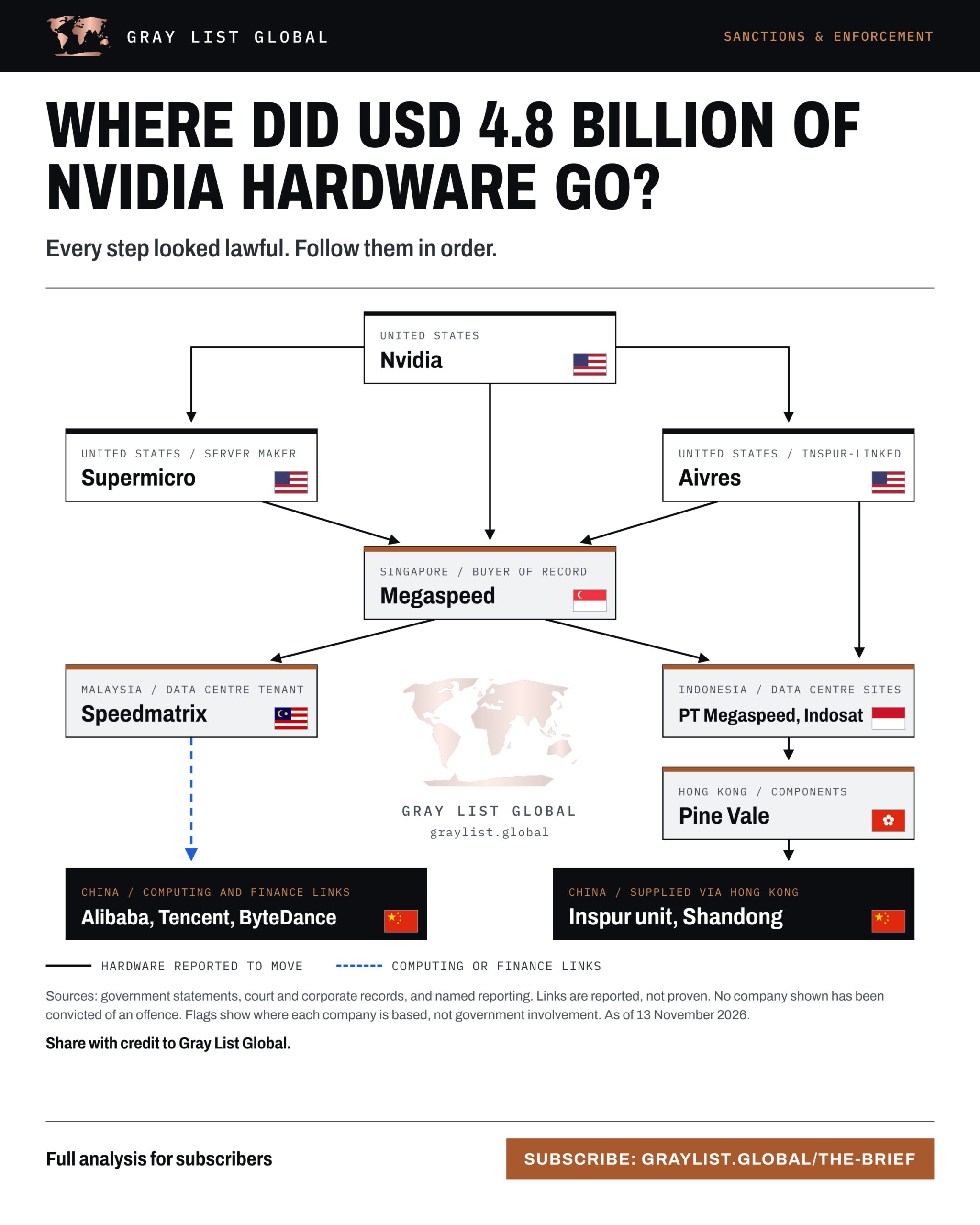
Summary: Three governments said this week that they are examining where Nvidia chips bought by one Singapore company ended up. Every step in the chain looked lawful where it happened. Put the steps in date order and a pattern appears: most of the structure was set up within months of a US restriction in 2023, and the same few names sit at both ends.
What Happened
On 12 November 2026 Singapore’s Ministry of Home Affairs said that servers bought by companies it is investigating were exported through Singapore to Malaysia without ever entering the local market. Police are now checking whether the servers travelled further, contrary to declarations made in Singapore. Megaspeed International and six individuals remain under investigation.
A day later Malaysia’s trade ministry said it was working with customs to establish whether chips imported by Megaspeed’s local arm, Speedmatrix, had been re-exported, and that it “has never cleared” either company, CNA reported. Nvidia’s chief executive resigned the same week.
Result
Megaspeed denies diverting chips and says it has hired a US law firm to count them. It has not been charged with anything.
In Washington the argument is over the Entity List, the US trade blacklist: American suppliers need a government licence to sell to any company on it. Treasury Secretary Scott Bessent said on 13 November that four agencies (Treasury, State, Defense and the Trade Representative) had wanted Megaspeed on that list “for months”, the Associated Press reported. The Commerce Department, which controls the list, has not added it. Singapore, for its part, says plainly that it does not enforce other countries’ export controls and acts only under its own law.
Impact: how the chain was built
The story starts before any chips moved. In 2018 China’s securities regulator fined Shanghai Hexi Investment 17.7 million yuan (about USD 2.7 million). Caixin reports that the firm’s founder was Kang Wei and that Alice Huang, also known as Huang Le, was a senior executive there. A year later, by the same account, the games company 7Road agreed to pay 1 billion yuan (about USD 145 million) for 12 gaming companies through an offshore structure involving Ms Huang.
Then the rules changed. In October 2022 the United States restricted exports of advanced AI chips to China. In March 2023 it put the Chinese server maker Inspur Group on the Entity List.
What followed took five months. That same March, corporate records described by CBS News show 7Road’s Singapore unit passing to a British Virgin Islands company called Huang Le Limited and taking a new name, Megaspeed, while Speedmatrix was set up in Malaysia. On 1 May Inspur’s California arm became Aivres Systems. A court complaint by Hewlett Packard Enterprise alleges the rename followed the listing, The Register reported, and the Wall Street Journal found the change in state business records. Aivres is not itself on the Entity List, though its reported parent, Inspur Electronic Information Industry, was added in March 2025. In July 2023 Apex Enterprise Solutions was incorporated in Singapore, and The Straits Times traced its ultimate ownership to Alibaba Group Holding. By the end of the year Megaspeed had passed to a company called Swiftdata, and Tan Yong Pong joined its board on the day Ms Huang left it.
Then the hardware moved. Between 2023 and 2026 Megaspeed and Speedmatrix bought about USD 4.8 billion of Nvidia equipment, according to CBS News. Kharon reports that Aivres was among the suppliers, and Singapore’s statement names Supermicro as another. Aivres alone exported at least USD 5.6 billion of technology to Southeast Asia between April 2024 and February 2026, according to the New York Times.
Money and components moved too. On 18 June 2024 Speedmatrix pledged IT equipment and related rights to Alibaba-owned Apex, an arrangement The Straits Times found still active on 11 November 2026. In August 2024 a Hong Kong firm later renamed Pine Vale won a bid to supply an Inspur-owned entity in Shandong, and Megaspeed’s Indonesian unit was shipping it data centre components as late as that November, Kharon reports from trade and procurement records. In July 2025 a Chinese listed company’s filings described renting computing power in Singapore. Kharon identifies the supplier as Megaspeed and the customers as Tencent and a firm serving ByteDance, though those matches are Kharon’s inference and not the filings’ own words.
A month later MSFusion, a Megaspeed unit classed as dormant only months before, agreed to pay RM263.21 million (about USD 62 million) for a data centre site in Johor, a Bursa Malaysia filing reported by EdgeProp shows. And in Indonesia, the Wall Street Journal reported, Indosat bought about USD 100 million of Nvidia racks from Aivres for a Shanghai customer, in a deal lawyers called compliant (via PC Gamer). Megaspeed’s Indonesian unit was later named alongside Indosat as a tenant of two planned data centres on Java, according to Journal Arta.
Governments noticed in stages. Singapore opened its own inquiry in February 2025 into possible false declarations in server purchases, and says no other country asked it to. It learned of US interest only on 24 June 2025, when American export officials inspected Megaspeed. Singapore police interviewed Ms Huang, then chief executive and chairperson, the same day. The next month Malaysia began requiring a permit to re-export high-performance US AI chips, though imports still need none, and Singapore told US authorities that Supermicro had given it limited cooperation.
In February 2026 Singapore found insufficient evidence that Ms Huang had committed an offence, warned her for understating her role and barred her return. In March US prosecutors charged three people linked to Supermicro with diverting about USD 2.5 billion of servers to China through Southeast Asia. One pleaded guilty in October, Fortune reported. No public evidence ties that case to Megaspeed.
The pattern
Set out in order, three things stand out. All three are Gray List Global’s own inference from the public record.
The first is timing. Inspur was restricted in March 2023, and Megaspeed, Speedmatrix, Aivres and Apex all took their present form between March and July of that year. This is timing only: no source says the events were coordinated.
The second is that the same name sits at both ends. An Inspur affiliate sells in California, and an Inspur-owned entity is supplied in Shandong, according to two separate reports.
The third is that more than one thing travels. Hardware went to Malaysia and Indonesia. Components went to Hong Kong. Computing power and a security interest point to China. Whether restricted chips themselves entered China is exactly what the investigations are testing.
Each government saw only its own segment: a sale in the United States, paperwork in Singapore, a permit-free import in Malaysia. None of those rules was broken on its face, and none of this shows intent by any of the three countries.
What to watch
Malaysian customs findings on re-exports since July 2025 will be the first hard test. After that, watch whether the United States lists Megaspeed, or writes a rule for renting restricted computing power across borders. Lenders and landlords have a nearer question: who holds security over a tenant’s hardware, and who that tenant’s customers are.
How the links are graded
- Confirmed (official record): the Singapore and Malaysian ministry statements; the two US Entity List actions on Inspur (Federal Register, 2023 and 2025) and the October 2022 chip rule; the US charges in the Supermicro case (Department of Justice); the Johor land sale (Bursa Malaysia filing, via EdgeProp).
- Reported (attributed in the text): everything credited to Caixin, CBS News, The Straits Times, Kharon, The Register, the Wall Street Journal, the New York Times, the Associated Press, Fortune and Journal Arta. CBS News and The Straits Times say they worked from corporate records.
- Inferred: the three points under “The pattern” (Gray List Global), and the identification of Megaspeed, Tencent and a ByteDance supplier in a Chinese company’s filings (Kharon).
Key entities
- Nvidia Corporation, Super Micro Computer, Aivres Systems (United States); Inspur Group, Inspur Electronic Information Industry (China).
- Megaspeed International, Swiftdata, Apex Enterprise Solutions (Singapore); Huang Le Limited (British Virgin Islands).
- Speedmatrix, MSFusion (Malaysia); PT Megaspeed International Indonesia, Indosat Ooredoo Hutchison (Indonesia); Pine Vale (Hong Kong).
- Alibaba Group Holding; Jiangsu Lettall Electronic.
- Alice Huang (Huang Le), not charged; Tan Yong Pong, Megaspeed chairman and chief executive; Kang Wei, founder of Shanghai Hexi Investment.
Sources
- Singapore Ministry of Home Affairs, statement, 12 November 2026: link.
- Nvidia Form 8-K, 12 November 2026: link.
- US Attorney’s Office, Southern District of New York, 19 March 2026: link.
- Federal Register, Inspur Group added to the Entity List, 6 March 2023: link.
- Federal Register, six Inspur subsidiaries added, 28 March 2025: link.
- CNA, 13 November 2026: link.
- The Straits Times, 12 November 2026: link.
- Kharon, 12 November 2026: link.
- Caixin, 10 November 2026: link.
- CBS News, 13 November 2026: link.
- Fortune, 12 November 2026: link.
- Associated Press, 13 November 2026 (via PBS NewsHour): link.
- The Register, 18 April 2024: link.
- EdgeProp, 9 September 2026: link.
- Journal Arta, 10 November 2026: link.
- PC Gamer on the Wall Street Journal’s reporting, 14 November 2025: link.
Gray List Global analysis is based on open sources and is not legal, financial, or compliance advice. Named parties are presumed innocent unless proven guilty. See our Disclaimer.
The Gray List Brief
The cards are public. Subscribe to get the full analysis.